A late-August Yahoo Finance report quoted Palm Beach County homeowner Barry Garcia, who was reacting to the state's announcement that insurance rates were finally trending down: "It has been going up, never went down." His comment reflects how the change can feel to homeowners. For a buyer closing on a house in El Cid, Old Northwood, or Flamingo Park this fall, a separate insurance requirement also matters.
Florida approved the largest Citizens Property Insurance rate cut in the company's 24-year history for 2026, and Palm Beach County policyholders are seeing some of the deepest reductions in the state. That's real. What hasn't moved an inch is the set of age-based rules that decide whether a house can be insured at all before a rate ever applies. For a buyer looking at property in West Palm Beach's historic districts, where nearly every home was built between the early 1920s and the mid-1940s, that distinction is the whole ballgame.
The Cut That Made Headlines and the Number That Didn't
The Governor's office announced in January that Citizens policyholders across the state would see meaningful reductions starting at spring 2026 renewals, with Palm Beach County's roughly 26,000 affected policies averaging an 11.9% cut. Kin Insurance followed in September with a 20% reduction for new and existing customers across Broward, Miami-Dade, and Palm Beach, calling it the largest single cut it has ever taken in Florida. State Farm, USAA, Allstate, GEICO, and Progressive all filed their own decreases in the 7% to 10% range this year.
Those numbers are accurate, and they're worth knowing if you're budgeting for a purchase. But the lived experience is narrower than the press release. Palm Beach County's average annual premium moved from $6,412 to $6,323 this year, a 1.4% decline, according to county-level data reported by a West Palm Beach outlet in late August. That's the actual number behind the average, not the headline cut applied to a subset of Citizens policies. Palm Beach still carries the second-highest average premium of any county in Florida, behind only Monroe County in the Keys.
None of that changes whether a specific house can get a policy in the first place. That question is decided by a different set of rules entirely, and those rules are keyed to the age of the house, not the direction of the statewide market.
Why an Age-Based Rule Doesn't Bend for a County-Wide Average
Florida's four-point inspection exists because insurers learned, the hard way, that a home's age predicts its claims risk better than almost anything else. Citizens requires one for any property owner, dwelling, or mobile home application on a property more than 20 years old, and most private carriers land somewhere in the same 20-to-30-year range, though some have loosened that threshold slightly in 2026 as underwriting has eased. The inspection covers exactly four systems: roof, electrical, plumbing, and HVAC. Nothing else. It isn't a substitute for a full home inspection, and it isn't optional if the carrier asks for it.
Roofs get their own separate rule. Citizens requires documented proof of at least five years of remaining useful life for shingle roofs older than 25 years, and for tile, slate, clay, concrete, or metal roofs older than 50 years. Without that documentation, or a permit showing the roof was replaced, a renewal or new application can be denied outright.
Here's the part that matters for this specific corner of West Palm Beach: a 20-year threshold and a 25-year roof rule assume you're dealing with a range of home ages, some tripping the wire and some not. In El Cid, Old Northwood, and Flamingo Park, there's no range. Every contributing home in these districts is well past the newest of those thresholds. The four-point isn't a possibility here. It's a certainty, on every single transaction, regardless of what the county average premium is doing.
What "Built in 1923" Means When the Inspector Shows Up
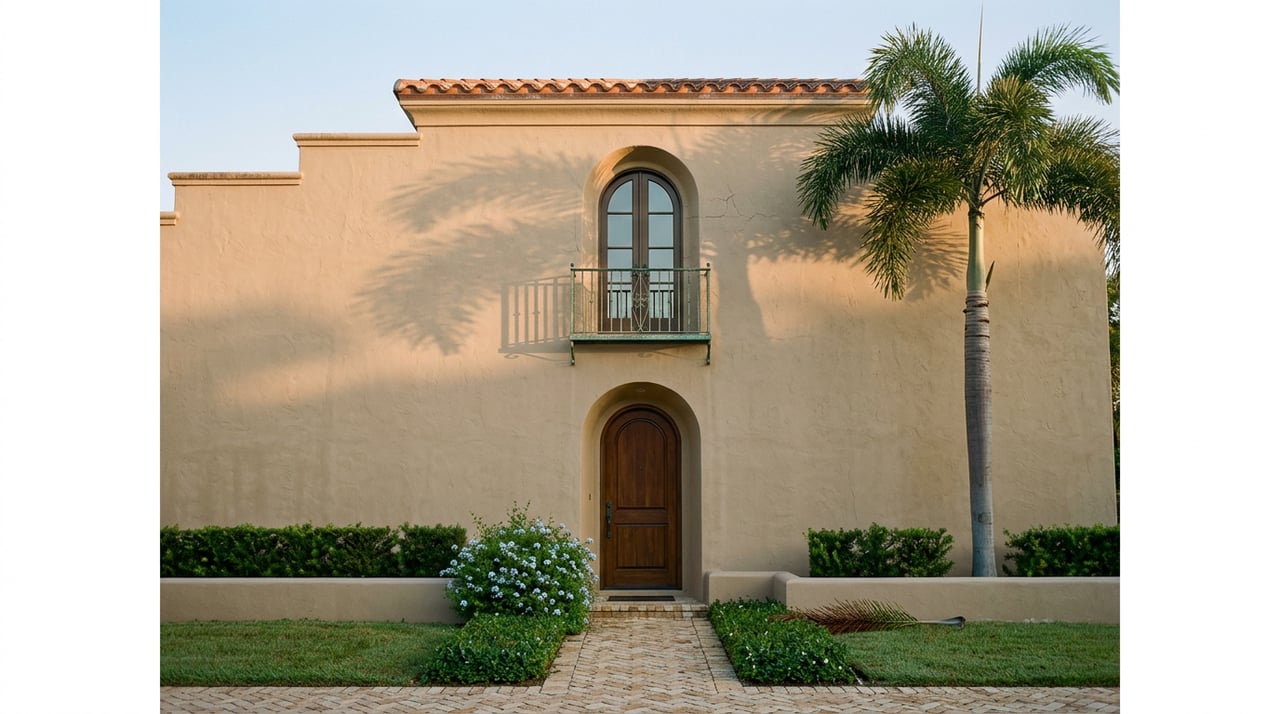
El Cid, bounded by Flamingo Drive, South Flagler Drive, Dyer Road, and South Dixie Highway, was developed starting in 1923 when Pittsburgh socialite Jay Phipps assembled a stretch of old pineapple fields along the Intracoastal and sold off lots to independent builders. The district's 281 historic buildings, most in Mediterranean Revival and Mission styles, were listed on the National Register of Historic Places in August 1995. Old Northwood went up between 1920 and 1927, with homes credited to architects including John Volk, and earned its National Register listing in June 1994. Flamingo Park, a roughly 95-acre district just south of downtown, traces to the same 1920s land boom and carries its own National Register status.
The market has caught up with that history. El Cid posted a median sale price of $3.0 million over the three months ending April 2026, working out to roughly $975 per square foot. Old Northwood's median climbed to $1,152,500 so far in 2026, up 53.7% from a year earlier. Flamingo Park has been trading around $1.2 million. These aren't discount properties where a buyer might shrug off insurance friction. They're some of the highest-value transactions in the city, and the closing timeline on a multi-million dollar contract is exactly where an insurance delay does the most damage.
| Historic District | Development Era | National Register Listed | 2026 Median Sale Price |
|---|---|---|---|
| El Cid | 1923 to 1926 | August 1995 | $3.0 million (3 months ending April 2026) |
| Old Northwood | 1920 to 1927 | June 1994 | $1,152,500 (up 53.7% YoY) |
| Flamingo Park | 1920s | 1999 | approximately $1.2 million |
The Four Systems That Actually Decide the Deal
A house built in 1925 doesn't still have its original wiring or plumbing, obviously. What it usually has is a patchwork of updates from whatever decade someone last touched the system, and that patchwork is exactly what a four-point inspector is trained to flag:
- Electrical panels, particularly Federal Pacific Stab-Lok, Zinsco, and Challenger brands, which were common installs from the 1950s through the 1980s and are now flagged by nearly every carrier due to documented fire risk
- Aluminum branch wiring, also common in mid-century renovations, which insurers treat as a heightened fire hazard compared to copper
- Polybutylene supply piping, used widely from the late 1980s into the 1990s and prone to failing without warning, a problem for any historic home that had plumbing redone during that window
- Roof age against the certification clock, since a re-roof done 24 years ago on a shingle roof, or one done without a retained permit, can trigger the same denial as a roof that was never replaced at all
None of these are hypothetical for this housing stock. A home that's a century old has, by definition, been through several rounds of electrical and plumbing work, and the era those updates happened in determines whether they pass or fail today's underwriting standards.
The Order of Operations That Keeps a Closing on Schedule
The practical fix is sequencing, not luck. Order the four-point and wind mitigation inspections during the option period, not after the mortgage commitment is already in motion. Ask the seller, before those reports are even scheduled, for permit records or contractor invoices on the roof, panel, and any plumbing repiping. A signed, approved permit for a re-roof can stand in for a roof certification inspection in some cases, and it's far faster to produce a document that already exists than to schedule a second inspector visit after a failure.
If a report comes back with a flagged panel or an aging roof, get a repair estimate immediately and put it in front of the lender and insurer before the closing date, not after. A four-point failure doesn't have to kill a deal in a historic district. It has to be caught early enough that the fix fits inside the timeline everyone already agreed to.
A Few Questions Before You Write the Offer
Does a low four-point score always kill a sale in El Cid or Old Northwood? Not automatically. A failed report typically means a repair requirement, a higher premium, or a request for additional documentation, not an outright refusal, especially if the flagged item (a panel, a section of wiring) can be corrected before the insurance binder is due.
Will the 2026 rate cuts apply the moment I buy? Only if you're inheriting or qualifying for a policy that's already been through the reduction. A new policy on a newly purchased home is underwritten fresh, based on that home's current four-point and roof certification results, not on the county's average trend line.
Should sellers in these districts get ahead of this? Ordering a four-point and wind mitigation inspection before listing gives a seller the chance to fix or disclose issues on their own terms, rather than reacting to a buyer's inspector mid-contract. In a district where every home clears the age threshold automatically, that head start is rarely wasted.
Falling insurance averages are genuinely good news for Palm Beach County. They just aren't the number that decides whether a century-old house in one of West Palm Beach's historic districts closes on schedule. If you're weighing a purchase in El Cid, Old Northwood, or Flamingo Park and want a read on what a specific property's systems are likely to face at underwriting, South Florida Luxe Life can walk through the timeline with you before you write the offer, not after the four-point comes back. Schedule your free consultation and let's map out what a smooth closing actually looks like for this kind of house.
This article is general information, not legal, tax or financial advice. Consult a qualified professional about your situation.